In-Person & Online December 16 & 17, 2026, Dallas Tx.


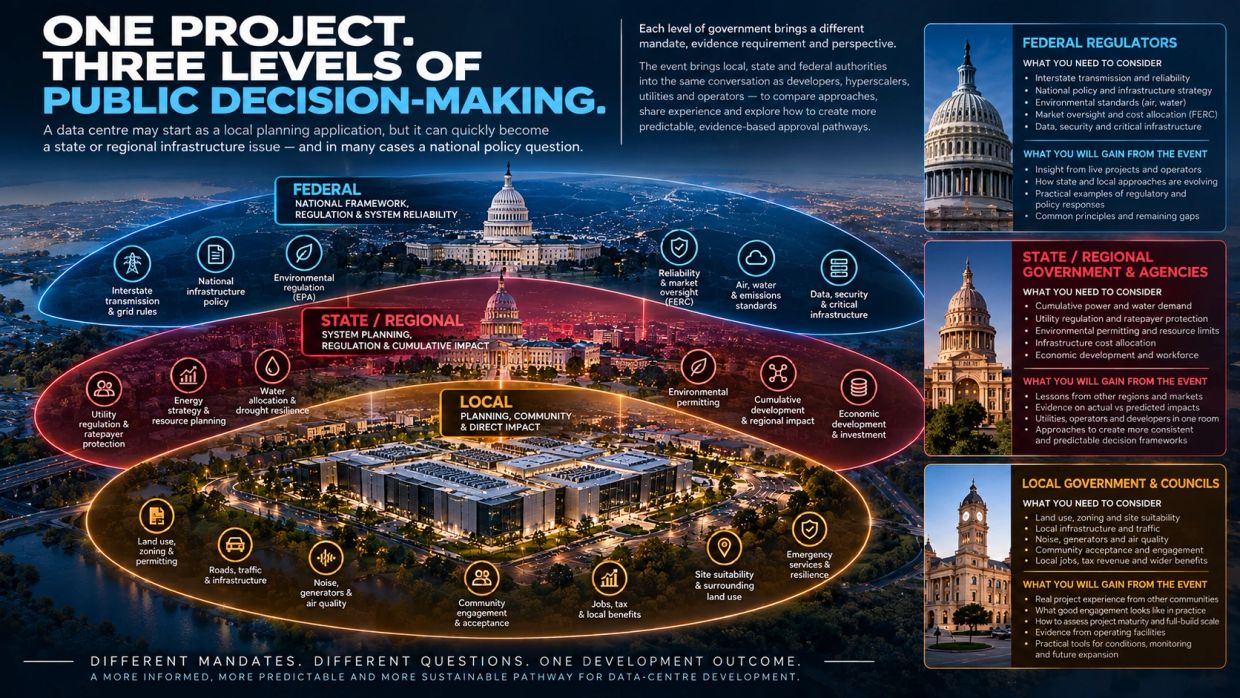
If you work in county or city government, planning or zoning, economic development, a public utility commission, state energy or water policy, environmental permitting or federal regulation, you are increasingly being asked to make decisions about projects that cut across far more than one conventional approval process.
A data center may arrive as a land-use application. But behind that application can sit questions about hundreds of megawatts of new demand, transmission, generation, water availability, roads, generators, noise, tax incentives, workforce, infrastructure funding, future expansion and who ultimately carries the risk if the project changes.
Our research with developers, hyperscalers and operators repeatedly identified government and regulatory decision-makers as essential to solving those questions — including county administrators, planning directors, zoning officials, economic-development directors, public utility commissioners, state water officials, state energy offices, environmental permitting agencies, elected officials and ratepayer advocates.
Inside a data-center company, power, water, land, environmental review, permitting, community engagement and infrastructure may all be managed by different teams.
Government does not get to assess them in isolation.
You ultimately have to decide whether the whole proposition makes sense for the locality or region.
Is the proposed scale clear?
Does the site remain appropriate at full build-out?
Are the power and water assumptions credible?
Who pays for supporting infrastructure?
Are community benefits proportionate to the impact?
What is genuinely committed and what is still aspirational?
What happens if the project changes ownership, operator or customer?
And importantly, what can still be changed by the public process when the project reaches you?
The research strongly reinforced that last point: if every significant decision has already been fixed before public participation begins, the process risks losing credibility regardless of how well it is communicated.
One of the most valuable aspects of this event for government is that you will hear directly from the organizations making the decisions upstream.
Developers will explain how sites are selected, when power and water risks become visible, how project maturity changes and what can genuinely still move during development.
Hyperscalers will explain how future load, density, cooling and expansion requirements are changing — and where they are taking greater responsibility for power, water and supporting infrastructure.
Colocation operators will explain a different challenge again: how existing sites serving multiple cloud, enterprise and AI customers can gradually intensify without necessarily appearing to be a completely new development.
Utilities will bring the system perspective: what they need before committing long-lived infrastructure, what evidence makes projected demand credible and where cost and non-delivery risk should sit.
That gives public-sector decision-makers a much better understanding of where uncertainty is genuine — and where better information, stronger commitments or different project design could remove it.
The research repeatedly demonstrated why government needs more than a headline MW figure, a headline water number or a headline investment figure.
A project may begin with one building while the land and infrastructure have been designed for a much larger campus.
The important questions therefore become:
What is phase one? What is the ultimate envelope? What infrastructure is needed at each stage? What is committed today? What remains optional? And at what point should the locality be updated again?
The research specifically called for clearer visibility of initial versus ultimate critical load, power-delivery phases, water requirements, transmission and generation dependencies, construction windows and which elements are committed rather than merely possible.
For government, that helps address one of the most damaging situations in public approval: when a community believes it approved one proposition and later discovers that the eventual project is materially larger or different.
The same challenge continues after approval.
A facility may have operated successfully for several years and remain entirely within the same property boundary.
But if it adds substantially more power, new generation, a different cooling architecture, new water infrastructure, another substation or additional buildings, is it still the same public proposition?
Our research repeatedly identified this as a crucial question for established sites.
A permit is not necessarily permanent evidence that every future intensification should be treated as immaterial. The issue is to establish where reasonable operational evolution ends and a materially different impact begins.
That matters enormously to local government, state regulators and environmental authorities because it helps create a more predictable basis for deciding when an amendment is sufficient and when a more substantive reassessment is justified.
The event also deliberately goes beyond approval-stage promises.
Government needs evidence from operating facilities.
Did actual power demand match the forecast?
Did actual water use resemble the approved assumptions?
Did noise modelling survive real operation?
Were road and infrastructure commitments delivered?
Did the expected jobs and economic contribution materialize?
Were community commitments maintained after construction?
And what happened when the operator sought the next phase?
That distinction between modelled and measured performance came through repeatedly in the research and gives government a much stronger evidence base for evaluating future applications and expansions.
This is an important part of the proposition.
The objective is not to teach government how to approve more projects.
Nor is it to assume that every proposed development can be made acceptable through better communication.
The research explicitly argued for distinguishing between a project that has simply been poorly explained, one where stakeholders were engaged too late, one whose physical or commercial design needs to change — and a project whose scale or location may simply not work. DEVELOPER CALLS (2)
But greater rigor can also create greater predictability.
Developers repeatedly said they need to understand what evidence government actually requires.
Government needs to know what developers can realistically provide at different stages.
Utilities need confidence before committing infrastructure.
Communities need to understand what is proposed and what remains uncertain.
One particularly strong research challenge was that local governments should be able to explain what predictable approval standards look like, just as developers, utilities and operators should be required to explain their own responsibilities.
That is the kind of conversation this event is built to facilitate.
Government and regulators are not being treated as an external stakeholder group brought in for a single “government panel”.
Their perspective has been built into the questions, panel discussions and case studies across the two days.
When a developer presents a site-selection case, the chair can ask:
What would the planning authority need to see before believing this site is genuinely executable?
When power infrastructure is discussed:
How are ratepayers protected and what happens if projected demand fails to materialize?
When water claims are made:
What does the water authority actually need to plan for peak demand, drought and future expansion?
When confidentiality is raised:
What information can legitimately remain confidential — and who should independently verify it?
When an operating project is presented:
Did the actual outcome match what was originally represented?
And when expansion is discussed:
At what point does the original approval case need to be revisited?
The objective is to give public-sector decision-makers a much clearer understanding of how data-center projects actually evolve, what information can reasonably be expected at different stages and where stronger evidence or clearer responsibilities can improve the quality of the decision.
You should leave better equipped to assess project maturity, full-build scale, infrastructure responsibility, ratepayer and community risk, disclosure, confidentiality, operating performance and material change — while learning how other US regions are approaching the same issues.
And equally importantly, industry participants should leave with a much clearer understanding of what government needs from them.