In-Person & Online December 16 & 17, 2026, Dallas Tx.


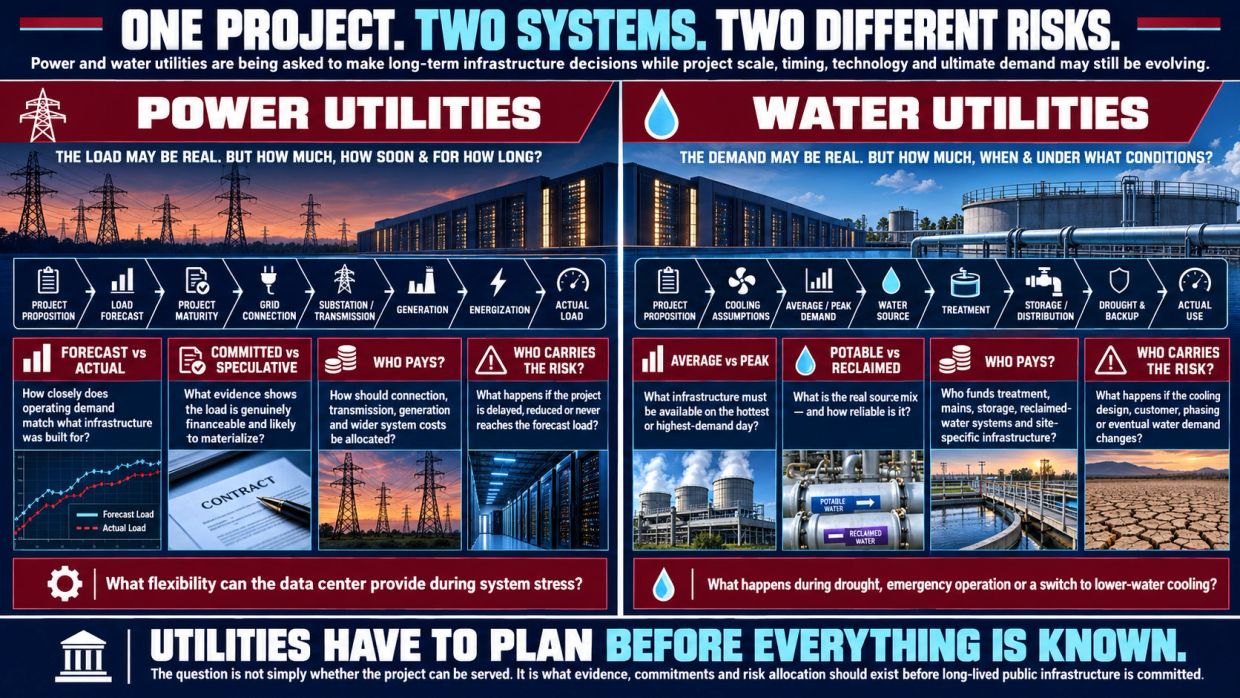
For power utilities, one of the strongest themes emerging from the research was credibility of demand.
The industry may talk about a 300MW, 500MW or gigawatt-scale development, but a utility has to know much more than the headline number.
What is phase one?
What is the ultimate build?
When will the load actually arrive?
How firm is the customer commitment?
How quickly will utilization ramp?
What happens if the customer changes?
What happens if 500MW of infrastructure is built and only 150MW materializes?
The research repeatedly identified the need to distinguish credible, financeable load from speculative or immature demand, because transmission, substations, distribution and new generation may have to be committed years before the final operating load becomes clear.
That leads directly to one of the biggest questions in the agenda:
The research goes considerably further than simply asking whether a data center pays its electricity bill.
It asks how responsibility should be allocated for:
For utilities, that is not primarily a public-relations question.
It is a system-planning, capital-allocation and ratepayer-risk question.
The event gives utilities an unusual opportunity to hear directly from the organizations creating the demand.
Developers will explain how project maturity changes between site selection, entitlement, customer commitment, financing and construction.
Hyperscalers will explain how quickly AI infrastructure requirements are changing and what they can realistically commit to around load, flexibility, onsite generation and future expansion.
Colocation operators add another layer: they may be aggregating multiple customers whose individual deployment schedules and eventual utilization are not fully known when infrastructure decisions have to be made.
That should help utilities understand where uncertainty genuinely exists — and where stronger commercial or contractual commitments could remove it.
The event also examines what data centers can contribute back to the system: demand response, flexible load, storage, dedicated generation and other forms of grid participation — while testing those claims against the realities of system operation rather than treating them as slogans.
The utility perspective is essential because developers and customers can describe what they want to build.
The power utility has to explain what the system can actually deliver.
That means challenging assumptions around:
energization dates, transmission dependencies, generation requirements, cost recovery, queue maturity, reliability, flexibility and the consequences of further expansion.
And importantly, utilities can help the rest of the room understand the difference between:
a technically possible connection, a commercially credible project and a development whose wider system requirements can actually be delivered on the timetable being proposed.
That distinction runs through the agenda.
The water-utility challenge is different — but remarkably similar in structure.
A developer may know that a site is likely to require water, while still not knowing the final customer, rack density, cooling architecture or ultimate campus build.
Yet the water utility may have to plan source capacity, treatment, pumping, storage, distribution, wastewater and drought resilience long before all of those variables are fixed.
The research repeatedly called for a much more disciplined distinction between:
planned demand, contracted demand and actual operating demand.
Those numbers should not be blended into one figure.
For water utilities, headline annual consumption is also not enough.
The agenda gets into the information that actually affects utility planning:
average demand, peak-day demand, ramp schedule, source, potable versus reclaimed water, water quality, cooling architecture, wastewater volume and chemistry, storage, backup supply and drought operation.
One of the most important findings in the research is that water and power cannot sensibly be considered in isolation.
Reducing routine water consumption may increase electricity demand.
Using evaporative cooling may reduce electrical demand while increasing water use.
A closed-loop liquid-cooled server system may consume relatively little water internally — while the facility still requires a completely separate method of rejecting that heat.
So the key question is not simply:
“Is this a waterless data center?”
It is:
That is why water authorities are needed alongside operators, design engineers and power utilities in these discussions.
The research also strongly supports reclaimed water as an area where utilities can add enormous practical value.
But again, the conference will go beyond simply celebrating reclaimed water as a sustainability solution.
The questions are much more commercial and operational:
Who funds the connection?
Who owns the offsite infrastructure?
Who owns specialized onsite treatment?
What minimum-volume commitment makes the investment