In-Person & Online December 16 & 17, 2026, Dallas Tx.


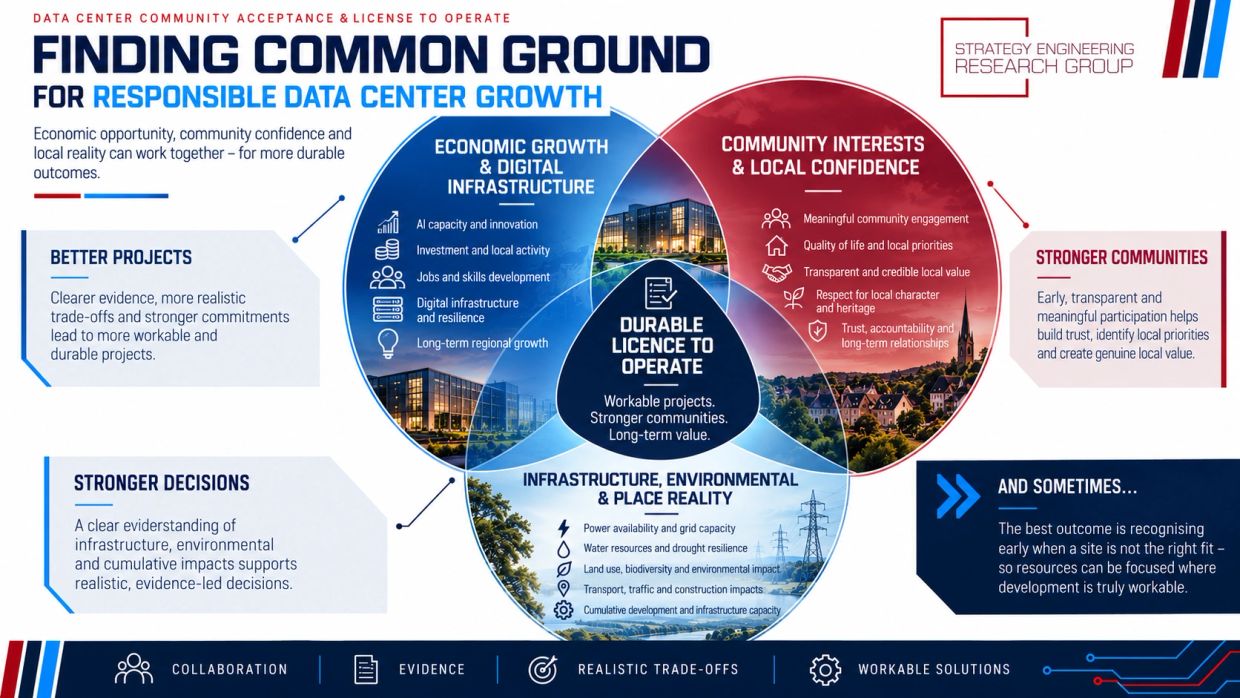
Community participation in data center development should not automatically be interpreted as opposition to development.
Many of the organisations now appearing in hearings, consultations, utility proceedings and local planning debates are not anti-data center. They are asking more practical questions: Is the project appropriate for this location? Is the evidence strong enough? Are the infrastructure responsibilities clear? Are the likely impacts understood early enough? Are local benefits credible? And if the project changes or expands later, what should happen then?
That is exactly why these perspectives need to be represented at Data Center Community Acceptance & Licence to Operate.
The event is designed to bring developers, hyperscalers, colocation operators, utilities, regulators, public authorities and community-facing organisations into the same room to examine where projects succeed, where confidence breaks down, what can be solved through better evidence or design, and where legitimate local concerns need to influence the development case itself.
We are particularly interested in participation from organisations that represent community interests in a constructive, evidence-led and procedural way, including:
Resident & Neighbourhood Associations
Representing people directly affected by proposed or operating facilities and bringing practical evidence around noise, traffic, lighting, construction, local infrastructure and quality of life.
Homeowners Associations & Civic Organisations
Providing an established local voice on land use, cumulative development, neighbourhood compatibility and long-term community impact.
Community Coalitions & Local Advocacy Organisations
Bringing together different community interests and helping identify where concerns are isolated, cumulative or shared across a wider locality.
Conservation, Watershed & Environmental Organisations
Providing expertise on land, water, habitat, drought resilience, infrastructure concentration and the environmental consequences of large-scale development.
Historic, Cultural & Landscape Preservation Organisations
Helping ensure that site history, cultural assets, landscape character and long-term land-use implications are properly understood before development decisions become fixed.
Ratepayer & Consumer Advocates
Representing community interests in questions around who pays for generation, transmission, substations and network upgrades, and how large-load infrastructure risk should be allocated.
Environmental Justice & Civil-Rights Organisations
Ensuring that cumulative impacts, procedural fairness and the distribution of benefits and burdens are properly considered.
Public-Interest, Planning & Land-Use Lawyers
Bringing legal and procedural expertise around zoning, public notice, environmental review, utility regulation, transparency and the integrity of the approval process.
Independent Technical Advisers Representing Community Interests
Including acoustic specialists, hydrologists, planning consultants, environmental scientists and other experts able to test modelling, assumptions and operating evidence independently.
Transparency, Good-Government & Public-Process Organisations
Helping improve the quality of disclosure, participation and decision-making, particularly where projects are moving quickly or important information remains provisional or commercially sensitive.
The objective is not to create an adversarial forum.
It is to bring responsible community and public-interest voices into the same discussion as the organisations developing, approving and operating these facilities, so that the industry can better understand what needs to be known earlier, what evidence is credible, what concerns can genuinely be mitigated, what commitments should be measurable and where the development proposition itself may need to change.
For community organisations, there is equal value in hearing directly from developers, utilities and regulators about the constraints they are working within — including project confidentiality, changing customer requirements, power-delivery uncertainty, infrastructure lead times, water sourcing, financing and the practical limitations of what can be known at every stage of development.
The most productive outcomes are unlikely to come from treating every community concern as obstruction, or every development proposal as inherently problematic. They come from creating a clearer shared understanding of what responsible development should demonstrate, what communities reasonably need to know, what standards should be expected, and how legitimate local concerns can be incorporated without making viable development impossible.
We therefore welcome participate from community representatives, civic organisations, public-interest bodies, legal advisers and independent experts who would like to contribute constructively as speakers, panellists, roundtable participants or delegates. Special discounts may be available for some public sector organisations.