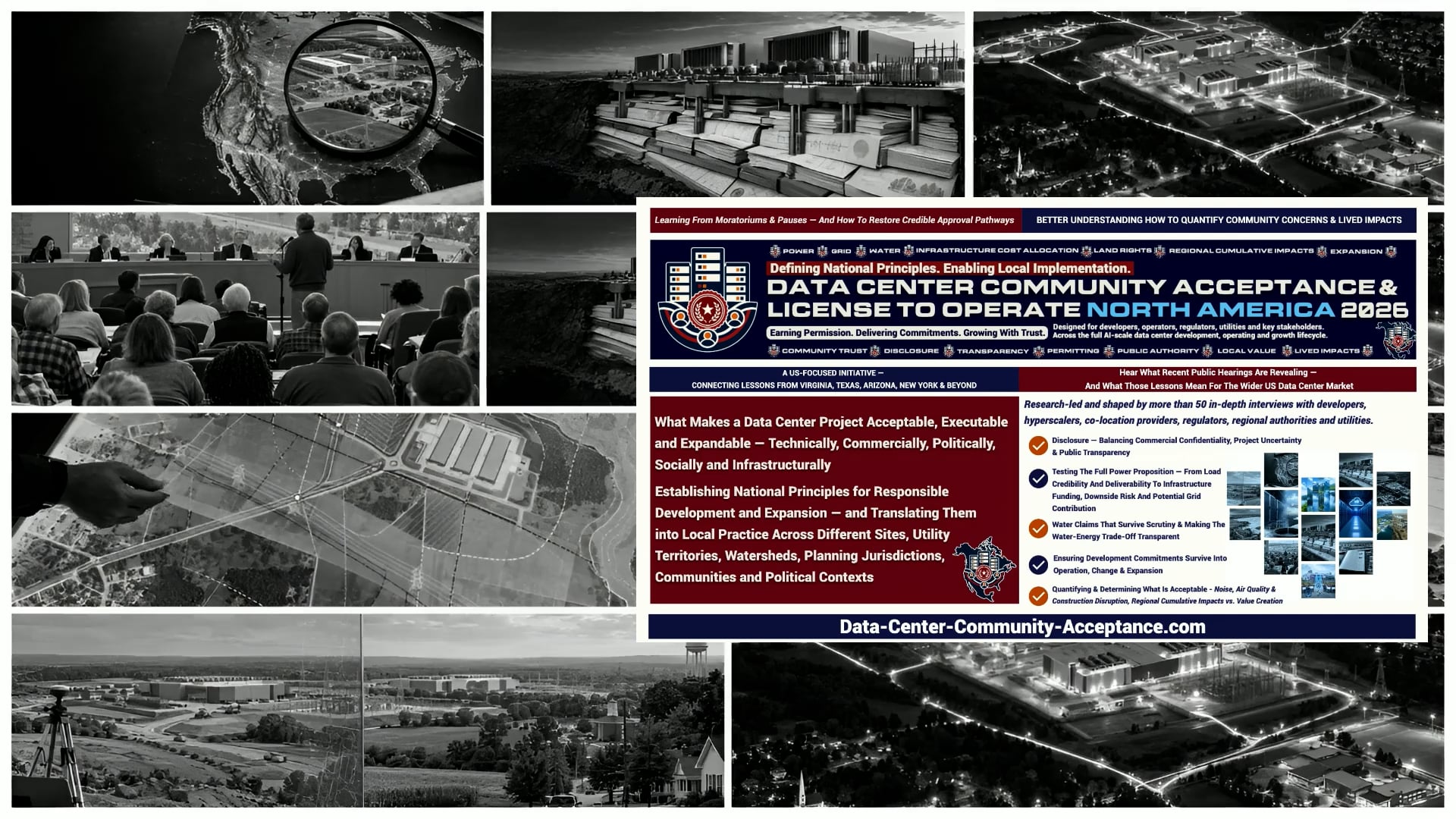
The latest moratoriums, hearings, development pauses and operating experience are beginning to reveal new constraints, new expectations and new evidence about what happens when AI-scale data center development meets the realities of a particular locality.
That includes the much-discussed questions around power and water — but increasingly also land history, cumulative development, infrastructure concentration, political tolerance, community expectations, noise, generators, transmission, traffic and whether the impacts actually experienced once a facility is operating correspond with what was originally modelled and promised.
This initiative brings those lessons together — and brings the organisations responsible for different parts of the development, approval and operating pathway into the same room.
It looks at how approval can become more navigable and predictable, but goes much further: how power uncertainty and large-load commitments can be managed more credibly; who should fund and carry the risk for new infrastructure; what good water disclosure actually looks like at site level; how terms such as “closed loop”, “waterless”, “near-zero” and “water positive” can be defined and compared consistently; how local watershed conditions and future demand should influence decisions; how cumulative development changes what remains workable in a particular region; and how predicted impacts compare with the lived experience of communities once facilities are actually operating.
We have called this initiative Data Center Community Acceptance & Licence to Operate because, in 2026, these issues are increasingly converging. The ability to build, operate and grow a data center now depends on much more than securing a permit or demonstrating technical viability.
A project can have land, capital, a credible customer, an engineering solution and an apparent route to power — and still encounter serious difficulty if the wider local proposition does not work.
That is why this business conference encompasses the political, community, infrastructure, environmental and commercial conditions that ultimately determine whether a project can proceed, whether the commitments made during approval remain credible once it is operating, and whether an existing site retains the ability to intensify or expand.
You told us during the research consultation that “Community Acceptance” is not a separate communications exercise added at the end of development. It is part of the wider licence to operate — and one of the conditions that determines whether that licence remains durable as projects move from development into operation and, ultimately, further growth.
Power, water, transmission, generation, land use, noise, traffic, economic benefit and infrastructure cost are therefore no longer isolated technical questions. Increasingly, they converge within the same approval and operating environment and influence the same political and community judgement about whether a development remains appropriate for a particular place.
The agenda and speaker panel will compare regional approaches and emerging best practice — what different jurisdictions are learning from pauses, hearings and contested projects; which principles could become more consistent; what must remain local; and how existing facilities can intensify or expand without assuming that the original approval case automatically extends to the next phase of growth.
Across our research calls with data center developers, hyperscalers, utilities and regulators, one of the most consistent themes was the need to identify a clearer set of national principles around the issues that repeatedly shape development — while recognising that implementation will still need to reflect regional, municipal and site-specific realities.
The agenda is designed to test where that common ground may exist, compare how different regions are already approaching the same challenges, and turn those discussions into practical takeaways on what could become a more consistent national expectation — and what must remain locally determined in practice.
The purpose is to turn those lessons into better-prepared projects, stronger evidence, clearer infrastructure responsibilities, more credible local commitments and a more workable basis for continued data center development and expansion.
FOR DATA CENTER DEVELOPERS, HYPERSCALERS & COLOCATION OPERATORS
Better Understand What Can Actually Determine Whether A Project Or Expansion Gets Through
A project may have secured land, identified a viable power strategy and demonstrated water availability and still encounter difficulty because other issues were underestimated or understood too late.
What is the history of the site? What was the land previously intended to become? How much data center development already exists locally? What additional transmission, substations or generators will be required? How will noise actually be experienced? And what happens when several individually acceptable projects create a cumulative impact that is no longer considered acceptable?
The agenda will draw lessons from approved and stalled projects, hearings, pauses, moratoriums and operating facilities to examine:
WHAT SHOULD HAVE BEEN KNOWN EARLIER
Where land history, community expectations, infrastructure or cumulative development have emerged late.
WHAT EVIDENCE NEEDS TO BE STRONGER?
Across power, water, noise, generators, economic benefit and environmental impact.
WHAT NEEDS TO BE SOLVED RATHER THAN COMMUNICATED AROUND?
Where design, mitigation or infrastructure choices need to change.
WHAT MAKES AN APPROVAL CASE MORE CREDIBLE?
And how initial development decisions can protect the ability to intensify and expand later.
FOR UTILITIES, POWER PROVIDERS & INFRASTRUCTURE PLANNERS
Utilities are being asked to plan around unprecedented individual loads and clusters of demand while the timing, certainty and ultimate scale of that demand may still be evolving.
A 500 MW or 1 GW campus can affect generation, transmission, substations, network reinforcement, transformers, equipment procurement and long-term system planning.
The issue is therefore not simply:
CAN THE POWER BE PROVIDED?
It is:
HOW CERTAIN IS THE LOAD?
WHEN DOES IT BECOME A CREDIBLE COMMITMENT?
WHAT MUST BE BUILT IN ADVANCE?
WHO FUNDS IT?
WHO PAYS OVER TIME?
AND WHO CARRIES THE RISK IF THE LOAD IS DELAYED, REDUCED OR NEVER MATERIALISES?
The event brings utilities together with developers, regulators and regional authorities to examine large-load commitment, infrastructure timing, financial responsibility, ratepayer protection and non-delivery risk.
FOR STATE, REGIONAL & LOCAL GOVERNMENT, PLANNING AUTHORITIES & REGULATORS
ENABLING GROWTH WITHOUT CREATING UNSUSTAINABLE LOCAL OBLIGATIONS
Authorities are increasingly making decisions that extend far beyond whether an individual facility technically complies.
They may need to determine:
Is this an appropriate use of this land?
Does it differ from what had previously been planned or expected?
How much similar development is already concentrated locally?
What new infrastructure will be required?
Who should fund it?
What is the cumulative effect on the grid, watershed, roads and community?
And what evidence should support claims around jobs, tax, water, noise and community benefit?
The agenda will compare how different jurisdictions are approaching these issues and explore where greater clarity could improve both development and regulation:
CLEARER APPROVAL EXPECTATIONS
EARLIER IDENTIFICATION OF CONSTRAINTS
CLEARER INFRASTRUCTURE RESPONSIBILITY
BETTER POST-APPROVAL MEASUREMENT
GREATER CONSISTENCY WITHOUT REMOVING LOCAL DISCRETION